Posts

How to Negotiate a Salary

Here are some valuable tips I found for salary negotiations: Commandment 1: Be Prepared Preparation is critical when negotiating the terms of your employment. The more information you have, the more successful you will be. This is so important that I have devoted a full chapter in my book to preparing for employment negotiations. This is the first commandment because it is the most important single thing you can do to ensure that you get the best deal possible. Commandment 2: Recognize That Employment Negotiations Are Unique Employment negotiations are different from other types of negotiations. They are not a one-shot deal like buying a house or a car. When the employment negotiations are over, you will have to work with your former "adversary" on a daily basis; more important, your career success may depend on the person with whom you have just finished negotiating. Therefore, even though you want to negotiate the best possible deal, you need to proceed in a way that doe...

Dan Pink: Why Rewards Don’t Work

http://lateralaction.com/articles/dan-pink-rewards/

Followup on ENFP=ADHD?

Of all my posts, it seems to be "ENFP=ADHD?" seems to be the most popular because of people googling similar phrases. Here's a direct link to it: http://entrepreneurness.blogspot.com/2008/11/enfp-adhd.html I conclude from this that other people must be sensing the relationship. My guess is most people aren't familiar enough with both terms to understand a correlation. But, if you've found your way here through a search engine... then obviously, you aren't most people. I've had a handful of people in my life like my mom and high school math teacher tell me that I had ADD. Being told that you have "Attention Deficit DISORDER" is not a pleasant thing to hear, so it felt like a kind of insult. No one wants to hear that something is wrong with them, especially when it feels like an insult to your personality and being. But here is the thing, I don't think it's a disorder.  I've found someone to agree with me, and she happens to ...

Stepping out

When either taking the jump out on your own, or being pushed there and into a place of self exploration, here are a couple of important things I have learned first hand along the way. 1)  Set up time limits and schedule yourself.  When you leave time to make decisions open, you may never make a decision because you are afraid of making the wrong decision.  There is no 100 percent correct decision, and variable are constantly changing.  If it is time you are taking to try and save money, factor in the extra time you are putting in to save this money, and ask yourself if it is worth the possible outcome. 2)  Trust the people you talk to before you tell them too much.  If you don't feel comfortable with the person or haven't reached the needed level of trust...do not tell the person too much.  Yes, there is that possibility that someone may steal your idea or tell others.  But, the larger factor in all of this is that they can bomb your...

Dealing and Stone Soup

Image
I went to a conference a year ago, and one of Silicon Valley's most well known venture capitalists, Tim Draper, gave a talk. He mentioned something along the lines of "You can't get anywhere in business without dealing. Creating a business is a series of deals.  Dealing to an entrepreneur is like breathing to a person" A light bulb went off when he said that, and since then those words have been rolling around in my head, because I think they carry more usefulness than just the business sense. First of all, do you know how to make stone soup? Once upon a time, there was a great famine in which people jealously hoarded whatever food they could find, hiding it even from their friends and neighbors. One day a wandering man came into a village and began asking questions as if he planned to stay for the night. "There's not a bite to eat in the whole province," he was told. "Better keep moving on." "Oh, I have everything I need," ...

The Basics of Product Design

Image
A designer must develop a product that by definition has the capabilities to meet some need that is not fully defined Seven basic actions of Problem Solving: 1. Establish the need or realize that there is a problem to be solved 2. Plan how to solve it 3. Understand the problem by developing requirements and uncovering existing solutions for similar problems 4. General alternative solutions 5. Evaluate the alternatives by comparing them to the design requirements and to each other 6. Decide on acceptable solutions 7. Communicate the results Planning occurs mainly at the beginning of a project.  Plans are always updated because understanding is improved as the process progresses.  These are called design iterations. There are 2 well known methods of design, the over-the-wall design method, and concurrent engineering . With the over-the-wall method, more often than not the customer is not content with the product that comes out of production.  Becau...

My Theories and Lessons Learned

Image
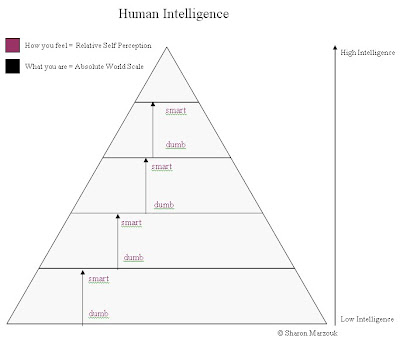
As I live life I tend to create my own theories/thoughts/guidelines as I start to notice patterns.  I like to document them as they come.  Here are some thoughts that have hit me lately. "Just before you begin to get smarter, you first feel really stupid"- SM  The graph below represents the population as a whole.  As people mature in their environment they are within one of the brackets and progress from 'dumb' to 'smart' as they understand the world around them better.  If they stay in their current environment, less is unknown to them and they maintain in a lower bracket in the pyramid, but at the top of their bracket.  If they choose to change their environment or a change is brought on forcing a drastic change, they will break through to a higher bracket , realizing that they knew less than they thought they did, but their potential for learning increases.  The pyramid represents the world population, people have a different 'maximum bracket' that...